Elektrik

  • Home
  • Privacy Policy
  • About
  • Related
Showing posts with label simple amplifier. Show all posts

Wednesday, 15 July 2015

Simple 150 Watt amplifier circuit using transistors

 dvbot     04:53     150 watt, 150 watt amplifier, cheap amplifier, simple amplifier, TIP142, TIP147, working simple     No comments   

This is the cheapest 150 Watt amplifier circuit you can make,I think.Based on two Darlington power transistors TIP 142 and TIP 147 ,this circuit can deliver a blasting 150 W Rms to a 4 Ohm speaker.Enough for you to get rocked?;then try out this.

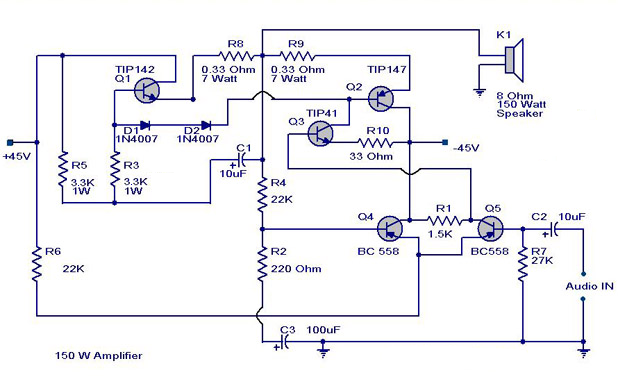
TIP 147 and 142 are complementary Darlington pair transistors which can handle 5 A current and 100V ,famous for their ruggedness. Here two BC 558 transistors Q5 and Q4 are wired as pre amplifier and TIP 142 ,TIP 147 together with TIP41  (Q1,Q2,Q3) is used for driving the speaker.This circuit is designed so rugged that this can be assembled even on a perf board or even by pin to pin soldering.The circuit can be powered from a +/-45V, 5A  dual power supply.You must try this circuit.Its working great!

The preamplifier section of this circuit is based around Q4 and Q5 which forms a differential amplifier. The use of a differential amplifier in the input stage reduces noise and also provides a means for applying negative feedback. Thus overall performance of the amplifier is improved. Input signal is applied to the base of Q5 through the DC decoupling capacitor C2. Feedback voltage is applied to the base of Q4 from the junction of 0.33 ohm resistors through the 22K resistor.

A complementary Class AB push-pull stage is built around the transistors Q1 and Q2 for driving the loud speaker. Diodes D1 and D2 biases the complementary pair and ensures Class AB operation. Transistor Q3 drives the push-pull pair and its base is directly coupled to the collector of Q5.

 Circuit Diagram & Parts List .


http://elektriktech.blogspot.com Simple 150 Watt amplifier circuit using transistors TIP 147 TIP 142
http://elektriktech.blogspot.com Simple 150 Watt amplifier circuit using transistors TIP 147 TIP 142 

Notes.

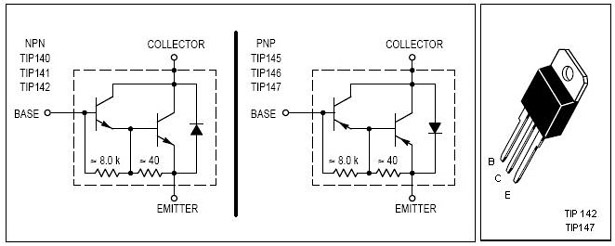
  • Remember TIP 142 and 147 are Darlington pairs  .They are shown as conventional transistors in figure for ease.So don’t get confused.Even though each of them have 2 transistors ,2 resistors and 1 diode inside ,only three pins ,base emitter and collector are coming out.Rest are connected internally.So its quite OK to assume each of them as transistor for ease.
  • Use a well regulated and filtered power supply.
  • Connect a 10K POT in series with the input as volume control if you need.Not shown in circuit diagram.
  • All electrolytic capacitors must be rated at least 50volts.

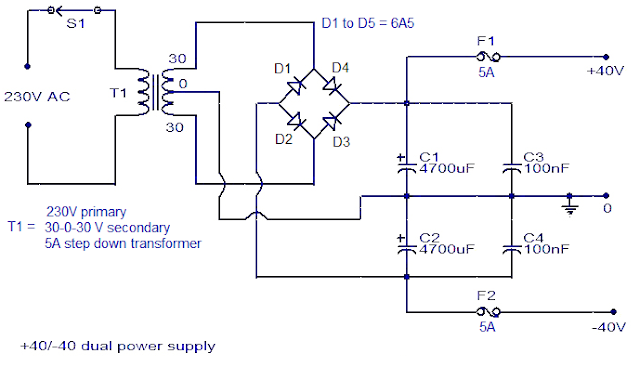
Power supply for this circuit.

A  +40/-40 unregulated dual supply for powering this amplifier project is shown below.  This power supply is only enough for powering one channel and for stereo applications double the current ratings of  the transformer, diodes and fuses.


http://elektriktech.blogspot.com Simple 150 Watt amplifier circuit using transistors TIP 147 TIP 142


TIP 142 & 147 Internal diagram and pin out.

http://elektriktech.blogspot.com Simple 150 Watt amplifier circuit using transistors TIP 147 TIP 142
 TIP 142-TIP 147 Pin Out Diagram with Schematics


Read More
  • Share This:  
  •  Facebook
  •  Twitter
  •  Google+
  •  Stumble
  •  Digg

Sunday, 5 July 2015

Simple audio amplifier using LM386.

 dvbot     03:06     amplifier, breadboard, cheap, cheap amplifier, integrated circuit, LM386, low component, simple amplifier     No comments   

The LM386 is an audio amplifier designed for use in low voltage consumer applications. The gain is internally set to 20 to keep external part count low, but the addition of an external resistor and capacitor between pins 1 and 8 will increase the gain to any value from 20 to 200.

Parts will be assembled and connected according to the following schematic:

This project uses an integrated circuit with capacity of 10 transistors to amplify much better with much less power drain on the batteries than our simple amplifier.


Following parts are required:
  • A LM386 integrated circuit amplifier chip
    This is the main working part of the amplifier.
  • A small speaker
  • Some jumper wires 
  • 9 volt DC adapter of 2 Amps or more or  9 volt battery clip and  9 volt battery  

The Three Penny Radio normally has a piezoelectric earphone attached at points J-20 and E-22. We replace the earphone with our amplifier.
Below is a closeup of the amplifier section:
 

 Here you can see that we have connected the Three Penny Radio output at J-20 to the ground rail below the blue line. This rail has all of its holes connected together. We connect the black (negative) wire from the battery to the ground rail. We connect the red (positive) wire from the battery to the power rail, just above the red line at the top of the photo. Having the power and ground connected to these rails makes it easier to connect the other parts, and makes it easier to see where all the connections are.

You can connect your audio source instead of radio.

The other output from the Three Penny Radio us plugged into E-22.
Using the labeled grid as before, the parts are connected this way:
  • LM386 amplifier chip at E-24, E-25, E-26, E-27 and F-24, F-25, F-26, and F-27.
  • Jumper wire: F-20 to ground rail.
  • Jumper wire: C-22 to C-26.
  • Jumper wire: A-25 to ground rail.
  • Jumper wire: A-27 to ground rail.
  • Jumper wire: J-26 to power rail.
  • Speaker: red wire to H-27 and black wire to ground rail.
  • Negative 9 volt battery wire (black): ground rail.
  • Positive 9 volt battery wire (red): power rail.
When all the wires are connected properly, you should be able to hear radio stations coming from the speaker. They will not be particularly loud, but we can increase the volume 10-fold with a simple adjustment.


We put a 10 microfarad capacitor connecting pins 1 and 8 of the integrated circuit (put the negative capacitor lead into hole D-24 and the positive capacitor lead into hole G-24).

This bypasses a resistor inside the integrated circuit, boosting the gain from 20 to 200.

One problem with the circuit so far is that the speaker will get warm and the battery will not last long. This is because a certain amount of DC current is going through the speaker. Direct current (DC) does not make sounds, and so this current is a complete waste of battery power, and simply warms up the speaker coil.


We fix this problem by putting a 220 microfarad capacitor between the integrated circuit output pin (pin 5, in hole F-27) and the red speaker wire. The positive capacitor lead is put into hole J-27, and the negative capacitor lead is put into hole J-29. The red speaker wire is moved to hole G-29.

To prevent the capacitor from changing the sound, we add two more components to create a "filter" that lets only audio frequencies get to the speaker.


Here we have moved the negative lead of the 220 microfarad capacitor to hole J-28, and moved the red wire of the speaker to H-28. We put a 10 ohm resistor into holes G-27 and G-30. A 0.047 microfarad capacitor goes into hole F-30 and the ground rail.

Our amplifier is working pretty well now. But our little speaker has a high tinny voice, because of its size. It would be nice if it had a little more power on the lower frequencies, what we call "bass response".

We can arrange to amplify the lower frequencies more than the high ones. We make another filter from a 0.033 microfarad capacitor and a 10,000 ohm resistor, and connect that between the output pin and pin 1 of the integrated circuit. This will feed some of the low frequencies back into the amplifier to be amplified again.

We put the 10,000 ohm resistor in holes C-24 and F-29. We put the 0.033 microfarad capacitor in holes I-27 and I-29.


 The amplifier is now ready with much better sound.


Read More
  • Share This:  
  •  Facebook
  •  Twitter
  •  Google+
  •  Stumble
  •  Digg

Wednesday, 10 July 2013

Audio Amplifier - 2N3055 MJ2955

 dvbot     02:51     150W, 2N3055, A564, amplifier, audio amplifier, C1162, cheap, D438, diy, easy, MJ2955, simple amplifier, transistor     No comments   

Here is A amplifier with 2n3055 transistors on its output for those of you that are looking at doing a bang for buck amplifier with all those 2n3055 lieing around that as most electronics guys think when they look in there old box there must be something I can do with this stuff.


Audio Amplifier circuit using 2N3055 MJ2955, A564, D438, C1162


Audio Amplifier circuit using 2N3055 MJ2955, A564, D438, C1162
R1 ………… 100K
26 ………… 30K
27 ………… 560
4 …………. 10K
5 …………. 1K
8 …………. 2K4
9 …………. 4K7
10 11 12 …… 100
13 14 ……… 300
15 16 ……… 0.5 5v
C1 ………… 100n
2 …………. 47uF
3 …………. 100pF
D1234 ……… IN414
Q124 ………. A564
5 …………. D438
6 …………. C1162
7 …………. MJ2955
8 …………. 2N3055


This is an easy to make power supply which has stable, clean and regulator 0-28V 6/8 Amp output voltage. By using two 2N3055 transistors we become more then 2 times the amount of amps then the power supply delivers, making it real though to brake ;). Although you could use this design to deliver 20 amps (with almost no modifications and with a proper transformer and a huge heat sink with a fan), I did not needed such much power. Make sure you mount them on a huge heat sink, as the 2N3055 transistors can get very hot at full load.

Read More
  • Share This:  
  •  Facebook
  •  Twitter
  •  Google+
  •  Stumble
  •  Digg
Older Posts Home

Popular Posts

  • Simple +-400Watt Amplifier using TDA7294 or TDA7293 + Power Transistors 2SC5200 and 2SA1943
    This additional part can be added to the traditional chip amp made using TDA7294 or TDA7293 to gain extra power in output. The traditional c...
  • Audio Amplifier - 2N3055 MJ2955
    Here is A amplifier with 2n3055 transistors on its output for those of you that are looking at doing a bang for buck amplifier with all tho...
  • Stun Gun Circuit Diagram using 555 timer IC
    CAUTION: Before going to explain about this circuit, we are going to strictly suggest that DO NOT TRY TO IMPLEMENT IT PRACTICALLY AS IT PR...
  • A simple 12V battery charger schematic using LM317
    This is a simple 12Volt Battery Charger Circuit which can be made using less components. This circuit can be modified using the formulas giv...
  • Simple 3 Watt and 5 Watt LED Driver Circuit Using IC 338
    The IC LM338 as we probably are aware, is a profoundly adaptable gadget with regards to controlling voltages and current levels. In the pres...
  • Simple 150 Watt amplifier circuit using transistors
    This is the cheapest 150 Watt amplifier circuit you can make,I think.Based on two Darlington power transistors TIP 142 and TIP 147 ,this c...
  • Lead Acid Battery Charger Circuit
    To successfully charge a battery, it should be supplied with DC current and not AC. This circuit shows how you can use DC voltage to regulat...
  • How to easily repair Momentary Switches used in boats
    Momentary switches make generators and motors begin at the push of a catch. In any case, when they don't begin, consider the switch as o...
  • Simple Car Audio Amplifier Circuit
    A straightforward low power car stereo amplifier circuit taking into account TDA 2003 is showed here. The circuit utilizes low cost, promptl...
  • All the new content will be added to new blog - http://elektriktech.blogspot.com/
    Please visit the new blog http://elektriktech.blogspot.com/ for new content. Apologies for the inconvenience.     http://elektrikte...

Pages

  • Home

Blog Archive

  • ▼  2016 (2)
    • ▼  August (2)
      • All the new content will be added to new blog - ht...
      • How to easily repair Momentary Switches used in boats
  • ►  2015 (23)
    • ►  December (1)
    • ►  November (2)
    • ►  October (2)
    • ►  September (2)
    • ►  August (4)
    • ►  July (10)
    • ►  June (2)
  • ►  2013 (1)
    • ►  July (1)
  • ►  2011 (3)
    • ►  August (3)

Dear Visitor

Please visit the new blog http://elektriktech.blogspot.com/ for latest and updated content.

Contact Form

Name

Email *

Message *

About Me

dvbot
View my complete profile

UPDATE!

Please visit the new blog http://elektriktech.blogspot.com/ for all new contents.

Translate

Subscribe To

Posts
Atom
Posts
All Comments
Atom
All Comments

Copyright © Elektrik
Distributed By My Blogger Themes | Blogger Theme By NewBloggerThemes